
English
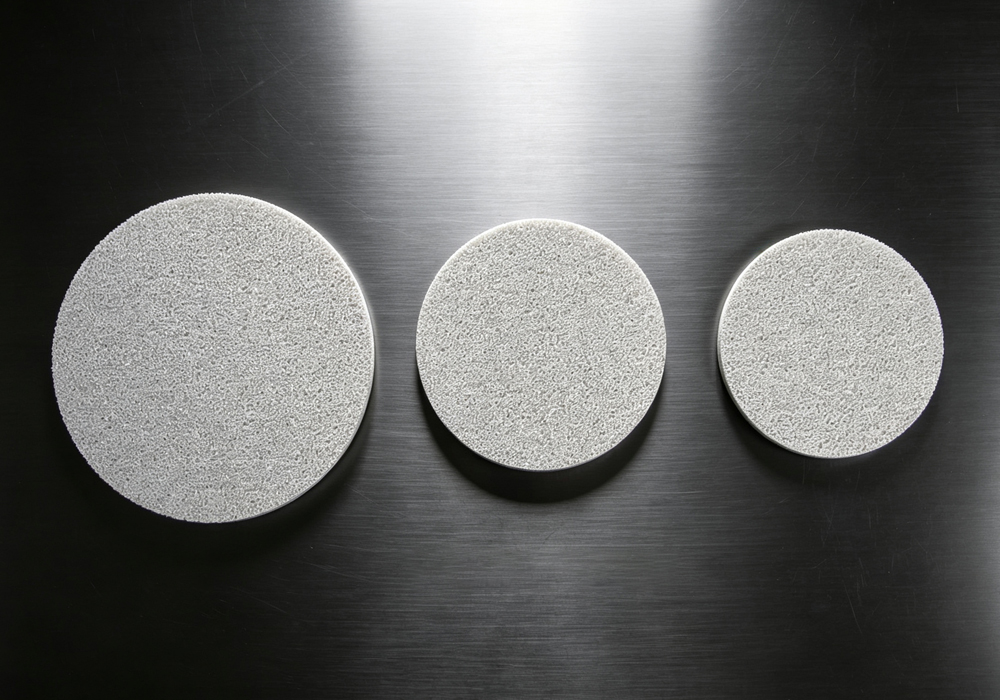
LAM GAS DISTRIBUTION DIFFUSION ELEMENT
Advantages
● Exceptionally high resistance to dry fluorine and fluorine-containing plasma etching
● Outstanding high-temperature resistance
● Resistant to plasma ion bombardment, ensuring a long service life
● Low metal leaching, no wafer particle contamination
● A mature, industry-standard material
Nickel reacts with fluorine to form a passivation film of nickel fluoride (NiF₂):
● The film is dense and strongly adherent to the substrate, with a melting point of 1360°C; it resists volatilization, cracking and peeling at high temperatures.
● High temperature resistance threshold: Remains stable up to 650°C in dry fluorine, making it the standard material for industrial fluorine storage tanks and semiconductor etching chambers.
● Slight solubility of the film prevents easy spalling under ion bombardment in plasma, resulting in an extremely low corrosion rate during long-term continuous production.
● Industry consensus: Pure nickel or Monel alloy is almost universally adopted for vessels and pipelines used to store and process high-purity fluorine.
Aluminum reacts with fluorine to form a passivation film of aluminum fluoride (AlF₃):
● Usable only for short-term exposure to dry fluorine at room temperature; its protective performance deteriorates rapidly with rising temperature, with a maximum service temperature of approximately 200°C.
● A large mismatch in thermal expansion coefficient between the film and aluminum substrate causes severe flaking, pulverization and peeling under thermal cycling and plasma impact.
● Once the passivation film ruptures, fluorine will rapidly and continuously corrode the base metal, with violent reactions occurring at high temperatures.
● Corrosion rate ranking for molten fluoride salts and high-temperature fluorine-containing atmospheres: Al ≫ Ni; aluminum corrodes far faster than nickel.
Detailed Classification by Working Conditions (LAM Etcher Diffuser Plate Scenarios)
● Nickel: Long-term stable performance, low metal elution, strong resistance to halogen plasma corrosion.
● Aluminum: Barely viable only for short-term low-temperature operation; continuous high-temperature processes generate persistent aluminum fluoride particles that induce wafer particle defects and deliver an extremely short service life.
For flow equalization/diffusion components in etchers: Nickel/nickel-based alloys are mandatory; solid aluminum foam is strictly prohibited.Aluminum may be used temporarily for short-term trials, yet it is unsuitable for mass-production continuous equipment. Nickel remains the recommended material for long-term engineering applications.
Intuitive Temperature Resistance Comparison (Dry F₂)
① Pure Nickel: Long-term stable at ≤650°C
② Aluminum Alloy: Short-term tolerance at ≤200°C; corrosion accelerates drastically above 200°C
LAM etcher diffuser plates and plasma chamber flow equalization components: Nickel/nickel-chromium alloy foam. It withstands fluorine-containing plasma, features low outgassing, and avoids particle contamination of wafers.
Supplementary Clarification of Common Misconceptions
① Aluminum is not entirely incompatible with fluorine; its performance is vastly inferior to nickel under high-temperature, plasma, or moisture-containing working conditions.
② While aluminum fluoride (AlF₃) itself is chemically stable, its poor bonding strength with the aluminum substrate leads to easy peeling during thermal cycling, eliminating its suitability for long-term protection. Nickel fluoride films feature robust substrate adhesion, delivering far superior engineering reliability compared to aluminum.